
A while back I published a piece on this site called 4 Walls and a Reality Check, about a project I worked on with an architectural firm partnered with Mayor Karen Bass’s office. The brief was housing insecurity at the Los Angeles Community College District - the largest community college district in the country, where more than half of 220,000+ students experience some form of housing insecurity. That piece is the case study. The frameworks, the research, what we proposed. This piece is what happened after.
The team was five designers. I was the fifth. The other four were architecture students. I was the only systems thinker, the only user experience researcher, and the only person whose discipline didn’t have a building as its default deliverable. That distinction did not feel important when we started the project. By the end it was the whole project.
When architects look at a housing-insecurity problem, the discipline gives them a default answer: build more housing. That answer is not wrong. It’s just not enough, and it’s not soon enough. Buildings in California, particularly buildings funded by community college district bonds, navigating state and local approvals, on land that has to be acquired or reclassified, take a long time. Five years is optimistic. Ten years is realistic. The students enrolled at LACCD when we started the project would have graduated, transferred, or dropped out long before the first new bed was available.
So I asked the question the discipline wasn’t built to ask: what about the students who are housing-insecure right now?
The framework we built. We mapped three intervention areas rather than one.
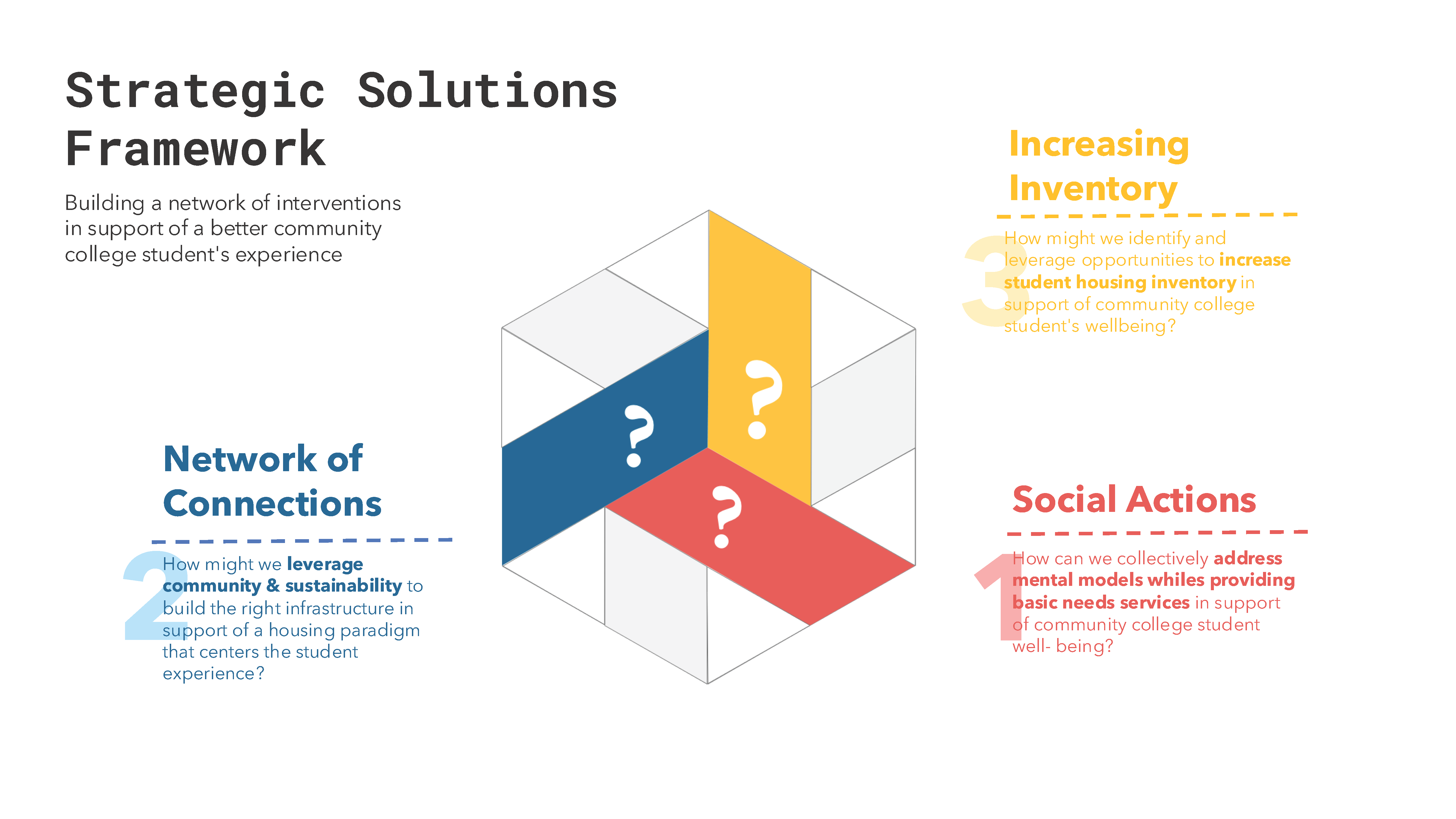
Social Actions addressed the stigma, mental models, and basic-needs services that determine whether a student even identifies as housing-insecure in the first place, and whether they ask for help when they are. Network of Connections addressed the community infrastructure that turns existing housing stock and existing services into a coordinated safety net, instead of a scattered set of programs no student has the bandwidth to navigate. Increasing Inventory addressed what the architectural firm already wanted to do, build more beds.
All three mattered. The point of the framework was that no single one of them solved the problem, and the fastest-helping interventions were the ones that didn’t involve breaking ground.
Then we plotted the timeline.
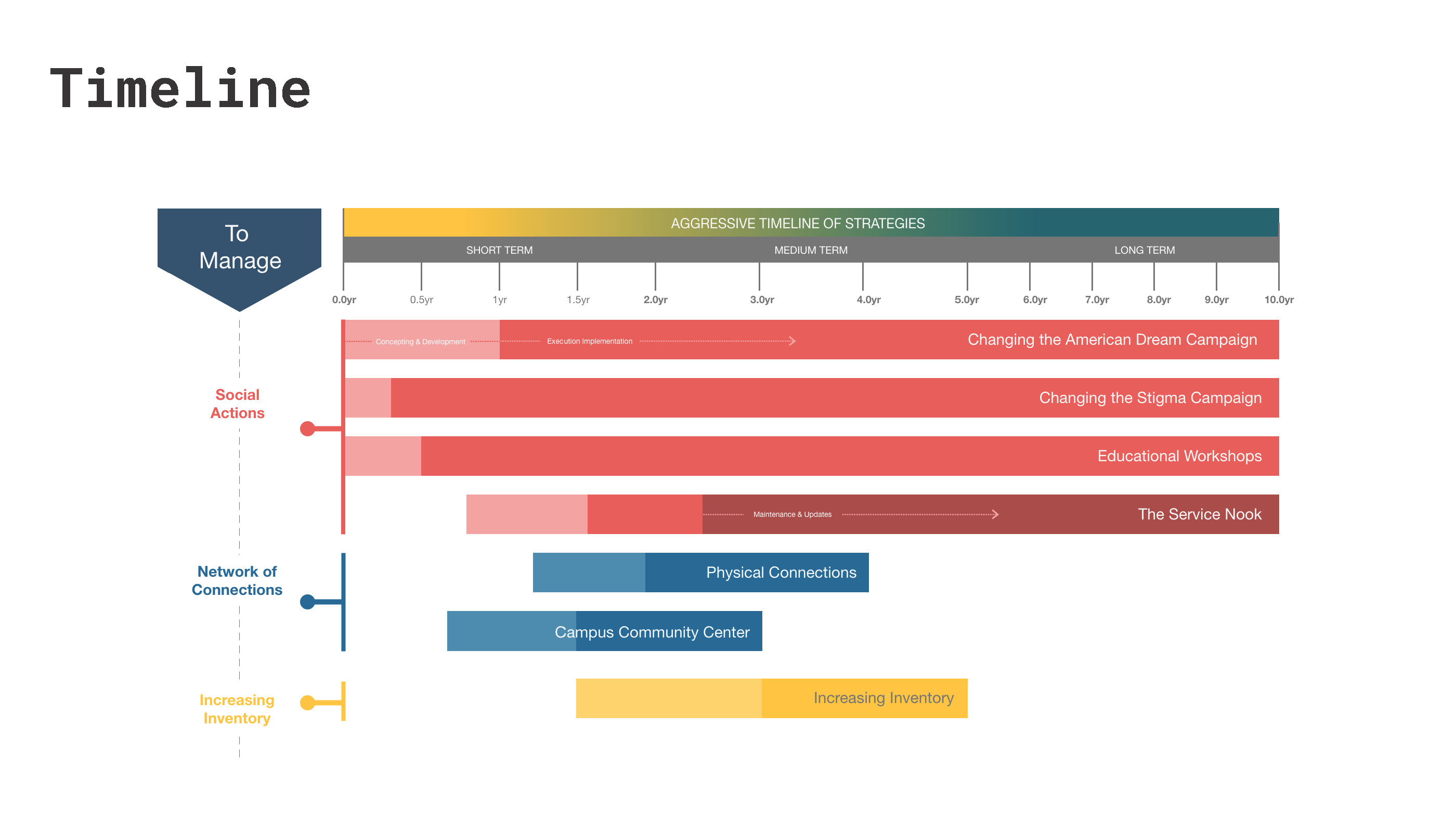
Seven distinct interventions across ten years. The campaigns and the community center could begin in year one. Physical Connections - coordinating existing housing stock with existing student services - could come online in year two. The Service Nook, a low-overhead basic-needs hub, could be operational inside eighteen months. And the new inventory, the part the firm was most interested in, wouldn’t begin meaningfully arriving until year three to five, with full impact in the long-term band. What the timeline showed, in a single image, was uncomfortable for the discipline most of the team belonged to. The architectural intervention was one of seven. It was the slowest to arrive. And on its own, it would help none of the students currently enrolled. The other six interventions could help students now, during the years the buildings did not yet exist.
What happened next?
The architectural firm shelved the project.
I didn’t get the news directly. Months later, I asked the program curator, someone I’d kept in touch with across the cohort, what had happened to it. She checked back with the team and came back with what she had: they liked the presentation, but they weren’t moving forward with it. She said other things too, things I don’t remember word-for-word, but the substance was that the work didn’t align with what the firm wanted to pursue commercially.
I have thought about that conversation a lot.
The most generous reading is that the firm couldn’t figure out how to make money from a framework where building new beds was one-seventh of the answer. Architects bill on construction. Stigma campaigns and service nooks and inter-agency coordination don’t generate architectural fees. A project whose recommendations were mostly not buildings was, structurally, not a project an architectural firm could sell to itself.
The less generous reading is that the firm liked the presentation in the way you like a thoughtful gift you have no intention of using. I’m not sure which reading is correct. I suspect both are, in different proportions, on different days, with different people in the room when the decision got made.
What I learned about systems thinking inside disciplines that aren’t built for it. This is the part I want to be honest about, because it’s the part the original 4 Walls piece didn’t say.
Every discipline has a default deliverable. Architects build buildings. Software designers build apps. Consultants build decks. Researchers build reports. The discipline isn’t wrong about what it produces; it’s just constitutionally unable to recommend something other than itself. When you bring systems thinking into a room full of practitioners from a single discipline, the systems work is welcome - until the systems work starts recommending that the discipline isn’t the answer. At that point the room gets quiet. The framework gets praised. The deliverable gets archived. This is not anyone’s fault, exactly. It’s how disciplines protect themselves. But it is the reason that “systemic solutions” so often die quietly after the final presentation. They die because the only people in the room who can act on them are people whose entire economic model depends on a different answer.
If you’re a systems thinker entering rooms like this, here is what I have learned to expect:
- The discipline-default solution will be in the framework whether you put it there or not. The architects were going to recommend buildings. Better to plot the buildings honestly inside a larger frame than to be the person trying to argue them out of buildings entirely. The framework didn’t fail because it rejected the architectural answer - it included the architectural answer. It failed because it refused to be only the architectural answer.
- “Aligned with business goals” is a more honest answer than it sounds. When a firm declines to move forward with a holistic project, it is usually telling the truth: the project doesn’t fit their revenue model. The work isn’t being rejected because it’s wrong. It’s being rejected because the firm can’t bill for it. Knowing this in advance changes how you scope the next project, and who you scope it with.
- The right partner for systems work is rarely the discipline-bound firm. The work I did for LACCD belongs at a foundation, a public-sector strategy team, a multi-disciplinary civic design lab, or a funder that’s measured in outcomes rather than billable hours. I went looking for that kind of partner after this project ended. I have not stopped looking.
- The framework outlasts the project. The Strategic Solutions framework and the ten-year timeline are still useful. They get used in other conversations, in other rooms, with other teams. A shelved project is not always a wasted project. Sometimes it’s just early.
The thing I’m still sitting with - the students whose housing insecurity we were trying to address are still housing-insecure. Some of them have graduated. Some have dropped out. Some are still enrolled, two or three years deeper into a crisis that the project would have started addressing in year one.
The buildings the firm wanted to build are also, mostly, not built yet. LACCD has passed a $5.3 billion bond for student housing since then, and is now in the long, careful process of figuring out how to spend it. The timeline our team plotted in 2023 turned out to be, if anything, optimistic. Meanwhile, the social-action and network-of-connections interventions, the parts of our framework the firm couldn’t sell, are roughly the things LACCD has had to assemble piecemeal in the years since, through nonprofit partnerships and basic-needs programs and emergency shelter coordination. Not because anyone hired our framework. Just because the need was there and the buildings were not.
I think that’s what systems thinking looks like, mostly. Not winning the room. Not getting the project funded. Just being early in a conversation that the world eventually has to have, with or without you.
The work I want to do is the work that gets to be early and funded. I’m still figuring out which rooms that work happens in.
If you’re building a public-sector strategy team, a civic design lab, or any kind of practice where systems work gets to lead rather than support a discipline-default solution, I’d love to talk. Get in touch.


